Jeff Dean: The Engineer Who Helped Build Google at Scale
From MapReduce and TensorFlow to Gemini and Discovery Loop, Jeff Dean’s work has shaped large-scale computing and modern AI.

Introduction
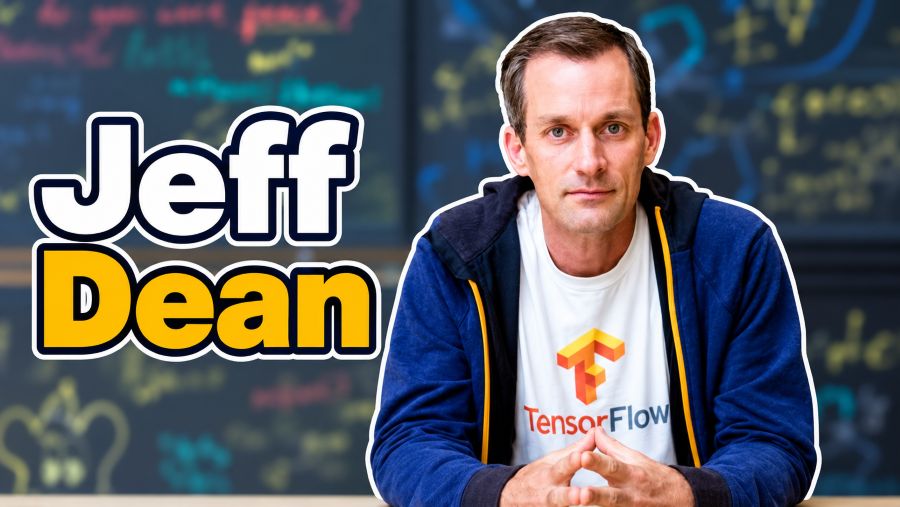
Jeff Dean spent nearly three decades building systems at Google.
Big systems. Really big ones.
His work touched Google Search, distributed computing, machine learning, TensorFlow, Google Brain, and Gemini. Then his career took a major turn in 2026.
Dean left Google after about 27 years.
He is now Co-Founder and CEO of Discovery Loop, an AI company started with Sanjay Ghemawat, Quoc Le, and Oriol Vinyals. The company aims to use AI to run and improve scientific and engineering experiments at much larger scale.
That move matters.
For years, Dean was mainly known as the engineer behind some of Google’s most important technical systems. Now he is building a company outside Google for the first time in decades.
Quick Facts About Jeff Dean
| Fact | Details |
|---|---|
| Full Name | Jeffrey Dean |
| Common Name | Jeff Dean |
| Profession | Computer scientist, software engineer, AI researcher |
| Nationality | American |
| Education | Computer Science and Economics |
| Undergraduate University | University of Minnesota |
| Graduation Year | 1990 |
| Ph.D. | Computer Science |
| Ph.D. University | University of Washington |
| Ph.D. Year | 1996 |
| Former Company | |
| Google Career | 1999–2026 |
| Former Google Role | Chief Scientist |
| Current Company | Discovery Loop |
| Current Role | Co-Founder and CEO |
| Main Fields | AI, machine learning, distributed systems |
| Known For | MapReduce, Bigtable, TensorFlow, Google Brain, Gemini |
| Longtime Collaborator | Sanjay Ghemawat |
| Spouse | Heidi Hopper |
Who Is Jeff Dean?
Jeff Dean is an American computer scientist and software engineer best known for his long career at Google.
He joined Google in 1999.
The company was tiny then.
Dean later worked on systems that helped Google handle enormous amounts of web data and computing traffic. His name appears on major technical projects such as MapReduce, Bigtable, TensorFlow, and other large-scale computing systems.
His work later moved heavily into AI.
Dean became closely linked with Google Brain, machine learning research, and Gemini. Before leaving Google, he served as Chief Scientist across Google Research and Google DeepMind.
Now his focus has changed again.
In August 2026, Dean and three longtime Google colleagues announced Discovery Loop, a public benefit company focused on automating parts of machine learning, science, and engineering research.
Early Life and Interest in Computers
Dean grew up in a family that moved frequently.
His parents worked in health-related fields. His father worked as a tropical-disease researcher, while his mother was a medical anthropologist.
Computer science caught his attention early.
That interest stayed.
Years later, he would spend his career figuring out how software could handle much larger amounts of information, faster processing, and bigger computing systems.
Those questions sound ordinary now.
They were much tougher then.
Education at the University of Minnesota
Dean attended the University of Minnesota.
He studied computer science and economics and graduated summa cum laude in 1990.
His university years mattered for another reason too.
He met Heidi Hopper, who later became his wife, while they were students at Minnesota.
Dean’s university work also gave him experience with computer science research before he entered graduate school.
The University of Minnesota later recognized him as one of its notable alumni.
Ph.D. at the University of Washington
Dean continued his education at the University of Washington.
He earned his Ph.D. in Computer Science in 1996.
His adviser was computer scientist Craig Chambers.
His research focused on whole-program methods for improving object-oriented software. In simple terms, he studied ways computers could analyze and improve a complete program instead of working with only small pieces of it.
The university confirms that Dean received his Ph.D. in 1996 and worked with Chambers on whole-program optimization techniques.
That systems background stayed useful.
Very useful.
Work Before Google
Dean did not begin his career at Google.
Before graduate school, he worked with the World Health Organization’s Global Programme on AIDS.
His work involved software used for statistical modeling and forecasting of the HIV/AIDS pandemic.
Later, Dean worked at DEC/Compaq’s Western Research Laboratory.
There he handled areas such as:
- profiling tools
- computer architecture
- information retrieval
- software performance
This period also connected him with Sanjay Ghemawat.
The two would later work together on some of Google’s best-known computing systems.
The University of Washington documents both Dean’s WHO work and his time at DEC/Compaq.
Jeff Dean Joins Google
Dean joined Google in 1999.
Google was still young.
Search traffic was growing quickly, and the company needed software that could work across huge groups of computers.
This became Dean’s territory.
He worked on multiple generations of Google’s crawling, indexing, and query-serving systems.
He also worked on Google’s early advertising infrastructure and AdSense systems.
But one problem kept getting bigger.
Google had mountains of data.
Engineers needed a simple way to process it across thousands of machines.
That problem helped lead to MapReduce.
MapReduce
Dean and Sanjay Ghemawat developed MapReduce at Google.
Their famous paper, MapReduce: Simplified Data Processing on Large Clusters, was published in 2004.
The basic idea was smart.
Break a huge computing job into smaller pieces. Spread those pieces across many machines. Then bring the results back together.
The system handled much of the ugly work behind the scenes, including machine failures, scheduling, communication, and data distribution.
So programmers could focus more on the actual task.
Google Research says MapReduce allowed large computations to process terabytes of data across thousands of machines.
Its ideas later influenced a lot of big-data software.
Bigtable
Dean was also one of the authors behind Bigtable.
Bigtable is a distributed storage system built for very large structured datasets.
And large means huge.
Google’s research paper described data running into petabytes across thousands of commodity servers.
Google used Bigtable for services including web indexing, Google Earth, and Google Finance.
The system became another important piece of Google’s computing base.
Spanner and Other Google Systems
Dean’s Google work went beyond MapReduce and Bigtable.
He helped work on or design systems connected with:
- Spanner
- Protocol Buffers
- search infrastructure
- advertising systems
- developer tools
- machine learning infrastructure
Spanner became known as Google’s globally distributed database system.
Basically, Google’s services were getting larger.
Dean kept working on software that could keep up.
Google Brain
Dean later moved heavily into machine learning.
He became one of the main figures associated with Google Brain.
Google Brain grew from efforts to train much larger neural networks using Google’s computing resources.
This was a natural move for Dean.
He already understood large computing systems.
Machine learning needed huge amounts of computation.
The two areas fit.
Dean eventually led Google Brain and became one of Google’s most visible AI research leaders.
DistBelief and the Road to TensorFlow
Before TensorFlow, Google researchers worked with an internal machine-learning system called DistBelief.
It helped teams train large neural networks across many machines.
But the team wanted something more flexible.
That work helped lead to TensorFlow.
Jeff Dean and TensorFlow
TensorFlow became one of Google’s best-known open-source machine-learning projects.
Dean was part of the large team behind it.
The system could run machine-learning computations across different types of hardware, including CPUs, GPUs, and Google’s custom Tensor Processing Units.
Google released TensorFlow as open-source software.
Researchers, companies, students, and developers around the world began using it for machine-learning work.
A 2016 Google Research paper lists Dean among TensorFlow’s authors and describes the system as software for large-scale machine learning across different computing environments.
One detail needs to stay clear.
TensorFlow was a team project.
Dean made major contributions, but calling him its sole inventor would be inaccurate.
Google’s AI Leadership
Dean’s responsibilities kept growing.
His work moved beyond individual systems and into research leadership.
He eventually led major parts of Google’s AI research operations.
His areas included:
- machine learning
- neural networks
- language models
- computer vision
- AI infrastructure
- large-scale computing
- AI applications
By this stage, Dean was no longer simply writing systems behind Google Search.
He was helping decide where Google’s AI research should go next.
Chief Scientist at Google
Google combined Google Brain and DeepMind into Google DeepMind in 2023.
Dean became Google’s Chief Scientist, working across Google Research and Google DeepMind.
His focus included major AI research directions.
One of those was Gemini.
Jeff Dean’s Work on Gemini
Dean held a senior technical role in Google’s Gemini project.
Gemini became Google’s main family of advanced AI models.
Dean was named among the senior technical leaders associated with the project, adding another major AI program to a career already linked with Google Brain and TensorFlow.
His Gemini work came late in his Google career.
Then came the big change.
He left.
Why Did Jeff Dean Leave Google?
Dean announced his departure from Google in August 2026, ending a career there that began in 1999.
He did not leave alone.
Three longtime colleagues joined him:
- Sanjay Ghemawat
- Quoc Le
- Oriol Vinyals
Together, they created Discovery Loop.
Reuters reported the group leaving Google as part of a major change involving several senior AI figures.
Dean described the move as a chance to work on automated experimental systems outside a huge company.
What Is Discovery Loop?
Discovery Loop is a public benefit company.
Its mission is focused on automated research.
The company wants AI systems to propose experiments, run tests, check results, learn from them, and then try improved experiments.
Again and again.
At scale.
The first area is machine-learning research and engineering.
The company says the same approach may later be useful in engineering, medicine, materials science, clean energy, and other research fields.
Radical Ventures currently lists Dean as Co-Founder and CEO of Discovery Loop.
The Discovery Loop Founding Team
Discovery Loop has four co-founders.
Jeff Dean
Dean brings decades of work in large-scale computing, Google infrastructure, and AI.
Sanjay Ghemawat
Ghemawat is Dean’s longtime collaborator and worked on major Google distributed systems.
Quoc Le
Le became known for deep-learning research and his work with Google Brain.
Oriol Vinyals
Vinyals worked on major AI research at Google DeepMind and held a senior role on Gemini.
The four founders had already worked together for many years before starting the company.
Jeff Dean and Sanjay Ghemawat
Dean and Ghemawat have one of the best-known engineering partnerships in Google’s history.
They worked together before Google.
Then they built systems together at Google.
MapReduce is probably their most famous joint work, but their collaboration covered much more.
Their skills matched well.
Both were deeply interested in software performance, distributed systems, and making large computing problems easier to handle.
Now they are working together again at Discovery Loop.
Personal Life
Dean is married to Heidi Hopper.
They met while studying at the University of Minnesota.
Hopper graduated from the university in 1990 with a bachelor’s degree in psychology.
The couple has supported educational and research work through charitable giving.
Dean generally keeps his private life away from the main focus of his public career.
That is worth respecting.
Claims about his exact personal wealth, salary, home value, physical measurements, or other private details should not be treated as fact without strong public records.
Awards and Recognition
Dean has received major recognition from the computing field.
His documented honors include membership or recognition from organizations such as:
- Association for Computing Machinery
- National Academy of Engineering
- American Academy of Arts and Sciences
- American Association for the Advancement of Science
He and Sanjay Ghemawat have also received recognition for their work on distributed computing systems.
The University of Washington records Dean as an ACM Fellow, National Academy of Engineering member, and AAAS Fellow.
What Is Jeff Dean Best Known For?
Different readers may know Dean for different reasons.
Older systems engineers may think of MapReduce.
Data engineers may connect him with Bigtable.
Machine-learning developers may think of TensorFlow.
AI researchers may know his work through Google Brain and Gemini.
Now there is Discovery Loop too.
The common thread is scale.
Dean has spent much of his career working on problems that become difficult once software, data, or machine learning grows very large.
Is Jeff Dean Still at Google?
No.
Jeff Dean left Google in August 2026 after roughly 27 years with the company.
Older Google and university pages may still list him as Google’s Chief Scientist because some profile pages have not been updated.
His current work is with Discovery Loop.
He is listed by investor Radical Ventures as its Co-Founder and CEO.
Final Thought
Jeff Dean’s career has moved through several computing eras.
Search came first.
Large distributed systems followed.
Then machine learning.
Then large AI models.
Now he is testing another idea: using AI to speed up research itself.
That makes Discovery Loop the part of his career to watch right now.
The older work still matters, though.
MapReduce, Bigtable, TensorFlow, Google Brain, and Gemini show how wide Dean’s technical record really is.
And after 27 years at Google, he has started again with a much smaller team.
That is a major career shift.
Frequently Asked Questions
Who is Jeff Dean?
Jeff Dean is an American computer scientist and software engineer known for his work on Google’s computing infrastructure and AI systems.
Is Jeff Dean still working at Google?
No. He left Google in August 2026 after about 27 years with the company.
What does Jeff Dean do now?
He is Co-Founder and CEO of Discovery Loop, according to Radical Ventures.
What is Jeff Dean famous for?
He is known for work connected with MapReduce, Bigtable, TensorFlow, Google Brain, large-scale computing systems, and Gemini.
When did Jeff Dean join Google?
Dean joined Google in 1999.
Where did Jeff Dean study?
He studied computer science and economics at the University of Minnesota and later earned a Ph.D. in Computer Science from the University of Washington.
Did Jeff Dean create TensorFlow?
Dean was part of the team behind TensorFlow. It was a large collaborative Google project, so describing him as its sole creator would be inaccurate.
What is Discovery Loop?
Discovery Loop is an AI company founded by Jeff Dean, Sanjay Ghemawat, Quoc Le, and Oriol Vinyals. It aims to automate parts of research and experimentation in machine learning, science, and engineering.