Lucy Mackintosh: The Historian Reading Auckland Through Place
A closer look at Lucy Mackintosh’s work, education, museum career, award-winning book, research, and current role at Te Papa.

Introduction
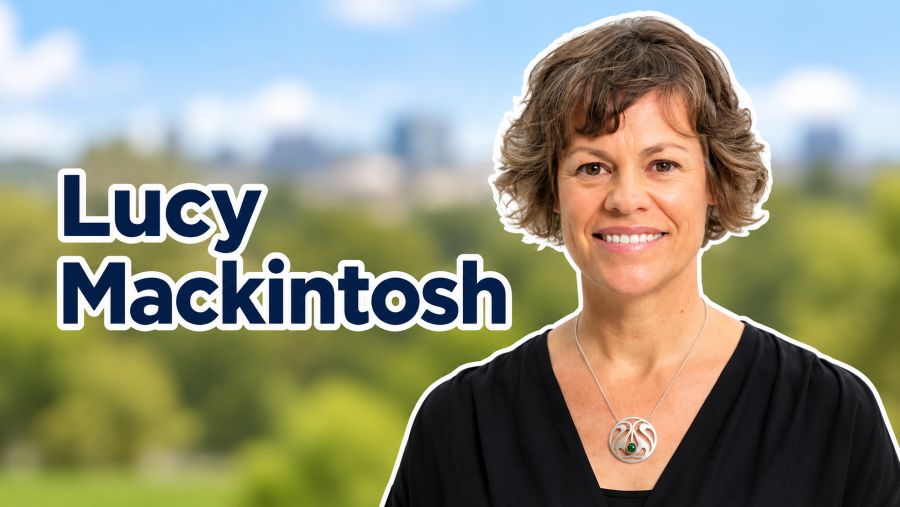
Lucy Mackintosh is a New Zealand historian, curator, researcher, and author. Much of her work focuses on Tāmaki Makaurau Auckland.
Her way of telling history is quite physical. Land matters. Objects matter. Old gardens, buildings, monuments, museum pieces, and changing landscapes can all carry stories that written records miss.
That approach sits behind her best-known book, Shifting Grounds: Deep Histories of Tāmaki Makaurau Auckland.
She has also worked at Auckland War Memorial Museum and, currently, at the Museum of New Zealand Te Papa Tongarewa.
Quick Facts About Lucy Mackintosh
| Detail | Information |
|---|---|
| Name | Lucy Mackintosh |
| Profession | Historian, curator, researcher, author |
| Nationality | New Zealand |
| Main field | New Zealand and public history |
| Education | BA, MA (Hons), PhD |
| MA university | University of Auckland |
| PhD university | University of Auckland |
| PhD completed | 2019 |
| Known book | Shifting Grounds: Deep Histories of Tāmaki Makaurau Auckland |
| Book published | 2021 |
| Former major role | Curator of History, Auckland War Memorial Museum |
| Current listed role | Curator New Zealand Histories and Cultures, Te Papa |
| Partner | Ben Lawrence |
| Children | Ruby and Joe |
Who Is Lucy Mackintosh?
Lucy Mackintosh is known for work that connects people with the places where history happened.
Basically, she does not treat history as something found only inside archives.
A hill can tell a story. So can farmland.
A museum object may carry clues about trade, family life, colonisation, migration, or cultural change. Mackintosh has spent much of her career looking at these connections.
Her research has paid close attention to Auckland and its long history before and after European settlement.
That includes Māori histories.
It also covers environmental change, colonial settlement, museum collections, public memory, and the ways later generations use historic places.
Her work has appeared through museums, academic publishing, public history projects, heritage research, and books.
Education
Mackintosh studied history at university before building her career in public history.
She completed a Bachelor of Arts. Later, she earned a Master of Arts with Honours in History from the University of Auckland in 1994.
Her master’s research looked at environmental history.
One focus was pollution in the Tarawera River after the opening of the Tasman Pulp and Paper Mill.
That topic says a lot.
Even at that stage, Mackintosh was interested in how people change physical places and how those changes become part of history.
Years later, the same idea appeared again in her work on Auckland landscapes.
Doctoral Research
Mackintosh began doctoral study at the University of Auckland in 2013.
Her research looked closely at history, memory, physical objects, and landscapes in Auckland.
She completed her PhD in History in 2019.
The thesis was titled:
“Shifting Grounds: History, Memory and Materiality in Auckland Landscapes c.1350–2018.”
Her supervisors included historian Caroline Daley and scholar Dame Anne Salmond.
The project examined long stretches of Auckland history rather than focusing on one short period.
That meant looking back centuries.
Mackintosh studied places where traces of earlier communities could still be read through land use, archaeology, buildings, planting, written records, and local knowledge.
Her doctoral work later became the base for her best-known book.
Scholarships and Research Support
Mackintosh received academic support while working on her PhD.
Her documented awards and scholarships included the Auckland War Memorial Museum Library Doctoral Scholarship, the Myra and Eric McCormick Scholarship, and the Keith Sinclair Scholarship.
The support gave her more space to carry out detailed historical research.
Auckland became the main subject.
But the research reached much further than city streets and official records.
She was interested in what sat underneath them.
Work as a Public Historian
Before taking a permanent museum curatorial role, Mackintosh spent many years working as a historical and museum consultant.
Her work included projects for government bodies, heritage groups, museums, and other public organisations.
This was practical history.
Not just academic writing.
She researched the past of particular sites and helped explain why those places mattered.
Documented projects included work connected with Duder Regional Park and Wenderholm Regional Park.
She also researched land use and occupation connected with Te Pūkaki Tapu O Poutukeka.
That kind of project requires a broad source base.
Written archives help.
So do maps, photographs, physical remains, oral accounts, and museum collections.
Mackintosh built much of her later research around that style of work.
Research in the United States
Mackintosh also spent time living and working in the United States.
For roughly two years, she lived in Connecticut and studied Māori objects held in American museum collections.
One major research site was the Peabody Essex Museum in Massachusetts.
She looked closely at Māori musical instruments held far away from Aotearoa New Zealand.
The basic question was simple.
How did these objects move?
Then came the harder questions.
Who made them? Who collected them? What happened to their meaning after they entered overseas collections?
This work resulted in published research on Māori taonga and musical instruments.
In 2012, she published “Holding on to Objects in Motion: Two Māori Musical Instruments in the Peabody Essex Museum.”
Her later writing continued that subject.
Auckland War Memorial Museum Career
Mackintosh joined Tāmaki Paenga Hira Auckland War Memorial Museum as Curator of History in 2017.
This became a major part of her professional career.
Her museum work covered social history and objects connected with New Zealand’s past.
A curator does far more than select things for display.
The work can involve checking provenance, researching objects, writing interpretation, planning exhibitions, working with collections, and helping visitors understand why an item matters.
Mackintosh brought her place-based historical work into that setting.
She served as Curator of History for around five years.
She later moved into a Senior Research Fellow position at Auckland Museum.
Collections to Classrooms
During her time as a Senior Research Fellow, Mackintosh was involved with Collections to Classrooms.
The project used museum collections to help school students learn more about the histories of Tāmaki Makaurau.
It connected museum objects with classroom learning.
That makes sense for her work.
She has repeatedly written history for audiences beyond universities.
Students, museum visitors, teachers, and general readers all appear in that wider public history space.
Current Work at Te Papa
Mackintosh is listed by the Museum of New Zealand Te Papa Tongarewa as Curator New Zealand Histories and Cultures.
Te Papa states that she took the position while curator Katie Cooper is on parental leave.
So the wording matters here.
It should not be presented as a confirmed permanent appointment unless Te Papa later updates the role.
Her move to Te Papa continues a career built around museum research, public history, collections, and New Zealand’s past.
Shifting Grounds
The work most closely linked with Mackintosh is her book:
Shifting Grounds: Deep Histories of Tāmaki Makaurau Auckland
Bridget Williams Books published it in 2021.
The book grew from her doctoral research.
It studies three major Auckland landscapes:
Pukekawa/Auckland Domain
Maungakiekie/One Tree Hill
Ōtuataua Stonefields at Ihumātao
These places have very long histories.
People have farmed them, built on them, remembered them differently, changed their names, placed monuments there, and argued about what they should mean.
Mackintosh uses those layers to tell Auckland’s story.
She pays attention to Māori gardening, colonial settlement, missionary activity, farming, Chinese market gardens, public monuments, and later debates about land.
The land itself becomes part of the evidence.
That is the book’s main strength.
It gives readers another way to think about a city they may believe they already know.
Why Ihumātao Appears in Her Work
Ihumātao became a major public issue in New Zealand during the dispute over proposed housing development on historically important land.
Mackintosh had already researched the area.
Her work explained why the site carried such deep historical importance.
The story stretches across Māori occupation, agriculture, missionary history, colonial land change, archaeology, and later urban growth.
She wrote publicly about the history of Ihumātao during the 2019 dispute.
Her research on the area also forms part of Shifting Grounds.
This made her academic work especially relevant to a live public debate.
Her Research Style
Mackintosh’s historical method is broad.
She reads written sources.
But she also looks beyond them.
Landscapes can keep traces of earlier use. Objects can carry evidence about the people who made or owned them. Planting, buildings, old roads, archaeological remains, photographs, maps, and oral knowledge may change the way a written document is understood.
That is basically how her place-based work operates.
She brings several kinds of evidence together.
Then she asks what the place itself can tell us.
Her work has also been influenced by thinking about places as changing rather than fixed.
Auckland, in this view, is not one story.
Its meaning changes across time.
Awards for Shifting Grounds
Shifting Grounds received strong recognition after publication.
In 2022, Mackintosh was a co-winner of the Ernest Scott Prize for History.
The book also won the Ian Wards Prize.
That award recognised its use of archival records.
It was named the Non-Fiction winner at the 2022 NZSA Heritage Book Awards.
The same year, it reached the shortlist for the Booksellers Aotearoa New Zealand Award for Illustrated Non-Fiction at the Ockham New Zealand Book Awards.
Recognition continued in 2023.
Mackintosh received the Erik Olssen Prize, given for a strong first book by an emerging historian working in New Zealand history.
Shifting Grounds was also named a co-winner of the inaugural Environmental History Book Prize from the Australian and Aotearoa New Zealand Environmental History Network.
The awards gave the book a much wider audience.
Selected Published Work
Mackintosh’s published and research work includes:
- Duder Regional Park: Our History — 2004
- Wenderholm Regional Park: Our History — 2005
- Te Pūkaki Tapu O Poutukeka: A History of Land Use and Occupation — 2009
- “Holding on to Objects in Motion: Two Māori Musical Instruments in the Peabody Essex Museum” — 2012
- “Intimate Immensity: A Pūtōrino in the Peabody Essex Museum” — 2015
- “‘A Long-Forgotten Art’: Two Māori Flutes in the Peabody Essex Museum” — 2017
- Shifting Grounds: History, Memory and Materiality in Auckland Landscapes c.1350–2018 — PhD thesis, 2019
- Public writing on the history of Ihumātao — 2019
- Shifting Grounds: Deep Histories of Tāmaki Makaurau Auckland — 2021
Personal Life
Mackintosh keeps her private life mostly outside public media coverage.
Her doctoral thesis acknowledgements identify Ben Lawrence as her partner.
The same acknowledgements name their children as Ruby and Joe.
She has shared very little else publicly about her home life.
That boundary is clear.
For a factual profile, there is no reason to fill the gaps with guesses.
Career Timeline
1994: Completed an MA (Hons) in History at the University of Auckland.
2000s: Worked on historical and heritage research projects.
2010–2012: Lived in the United States and researched Māori objects held in museum collections.
2013: Began her PhD at the University of Auckland.
2017: Became Curator of History at Auckland War Memorial Museum.
2019: Completed her PhD in History.
2021: Shifting Grounds was published by Bridget Williams Books.
2022: Received several major book and history awards.
2022 onward: Worked as a Senior Research Fellow at Auckland Museum.
2023: Received further recognition for Shifting Grounds.
Current: Listed by Te Papa as Curator New Zealand Histories and Cultures while Katie Cooper is on parental leave.
Why Lucy Mackintosh’s Work Stands Out
A lot of public history starts with documents.
Mackintosh often starts with place.
That small change makes a difference.
Readers can see how one patch of land may carry stories from very different periods.
Basically, the past does not disappear just because a city changes.
Some traces remain.
Her research tries to find them.
That is why her work moves easily between museums, environmental history, Māori history, public debate, heritage research, and books written for general readers.
Final Thought
Lucy Mackintosh has built her career around one clear idea: history can still be read in the places around us.
Her work in Auckland made that especially visible.
From museum objects to the volcanic landscapes of Tāmaki Makaurau, she has spent years checking what remains, asking what changed, and explaining those stories to the public.
Shifting Grounds brought that work to a much larger audience.
Her museum career continues the same path.
Research first. Then make it understandable.
Frequently Asked Questions
Who is Lucy Mackintosh?
Lucy Mackintosh is a New Zealand historian, curator, researcher, and author. She is known especially for her work on the history of Tāmaki Makaurau Auckland.
What is Lucy Mackintosh known for?
She is best known for writing Shifting Grounds: Deep Histories of Tāmaki Makaurau Auckland and for her museum and public history work.
Where did Lucy Mackintosh study?
She completed postgraduate study at the University of Auckland, including an MA (Hons) in History and a PhD in History.
When did Lucy Mackintosh complete her PhD?
She completed her PhD at the University of Auckland in 2019.
What is Shifting Grounds about?
The book studies the deep histories of Auckland through Pukekawa/Auckland Domain, Maungakiekie/One Tree Hill, and the Ōtuataua Stonefields at Ihumātao.
Did Lucy Mackintosh work at Auckland Museum?
Yes. She joined Auckland War Memorial Museum as Curator of History in 2017 and later worked there as a Senior Research Fellow.
Where does Lucy Mackintosh work now?
Te Papa currently lists her as Curator New Zealand Histories and Cultures, covering the role while Katie Cooper is on parental leave.
Has Lucy Mackintosh won awards?
Yes. Her book Shifting Grounds has received several awards, including recognition from the Ernest Scott Prize, Ian Wards Prize, NZSA Heritage Book Awards, Erik Olssen Prize, and Environmental History Book Prize.