A single wrong birth year, published once, becomes the birth year that forty sites agree on.
The mechanism is unglamorous. Somebody guesses or mistypes, a second site copies it because the first appeared authoritative, a third copies the second, and within a year the figure has enough apparent corroboration that correcting it looks like the error. Nobody involved acted dishonestly and the record is wrong anyway.
That is the central problem with biographical writing online. The overwhelming majority of it is assembled from other articles rather than from anything documentary, and the resulting agreement between sources is circular rather than confirmatory.
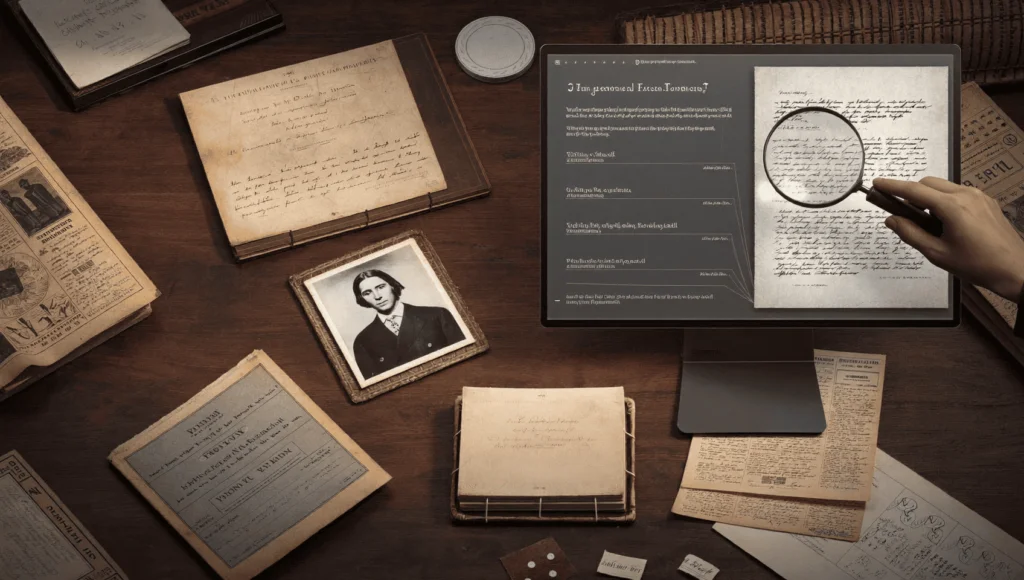
Working from documents is the only answer, and the documents are frequently scanned. Gemini Omni Flash reads those scans directly, and Higgsfield offers it in a browser, and the verification discipline is what makes it worth anything.
Why Does Agreement Between Sources Mean So Little?
Because they are usually all copying one original.
- Twenty sites agreeing may represent one source
- Aggregators cite each other in loops
- Errors gain authority through repetition
- Correcting late is harder than getting it right
- No Gemini Omni Flash summary distinguishes copies from sources
Tracing a claim backwards is the only real test available. Follow each source through to whatever it actually cites, and a great many biographical facts resolve to one unattributed assertion made somewhere years ago.
Where every path leads to one place, you have one source rather than twenty, and that source may be nothing.
Treat convergence between sources with suspicion rather than with relief.
What Counts as a Primary Document?
Something created by or filed with an institution.
- Company registers, which a Gemini Omni Flash read handles well
- Court and probate records, where public
- Professional registers for regulated occupations
- Published interviews where the person speaks directly
- Obituaries in papers of record
Company registers are comfortably the most underused resource available in this field. In jurisdictions operating open registers, a directorship record carries a date of birth to the month, appointment and resignation dates, a service address and every connected company.
Probate records settle estate and inheritance questions that otherwise circulate indefinitely as speculation.
A published interview is primary for what the person said about themselves and secondary for everything else in the article.
Where Does Document Reading Help?
Scans, which defeat ordinary text extraction.
- Archival newspaper pages, photographed or microfilmed
- Register entries scanned at low quality
- Filings issued as image PDFs
- Handwritten records, within limits
- A Gemini Omni Flash pass locating a name across many pages
The locating function is the realistic one. Finding which of four hundred archive pages mentions a person is the task; reading that page carefully is still yours.
Archive quality is frequently very poor indeed. Microfilm scanned decades ago and digitised again produces images that conventional text extraction cannot touch at all and that image reading handles reasonably well.
Handwriting remains unreliable. Treat anything read from a handwritten record as a prompt to look at yourself.
What Must Never Be Stated Without a Source?
Four categories, all routinely asserted.
- Never state a birth date you cannot document
- Never report a relationship from a single aggregator
- Never present net worth as established fact
- Never infer a family link from a shared surname
- Never publish a Gemini Omni Flash extraction unverified
The net worth problem is particularly specific to this category of writing. Those figures are estimates produced by a single publication using an undisclosed methodology, and they become established facts purely through being repeated often enough.
Attribute them where you use them. A figure described as an estimate by a named publication in a named year is honest; the same figure stated flatly is not.
The surname inference produces the worst outcomes of any error in this field, because it connects two people who are entirely unrelated and then publishes that connection as though it were established.
Does Wikipedia Count as a Source?
It does not, and its own policies say so.
Wikipedia is a tertiary source that summarises others, and its guidance explicitly discourages citing it in work that needs reliability. The useful part is the reference list at the foot of the page.
What to do with it instead:
- Read the references, not the article text
- Open each cited source and check it says what is claimed
- Note which claims carry no citation at all
- Check the talk page for disputed facts
- Never treat a Gemini Omni Flash summary of it as a source either
The uncited claim is the one to watch. Biographical articles frequently carry dates and details that nobody ever sourced, and those are precisely the facts that propagate outward into everything else.
The talk page is genuinely useful and almost never read. Where editors have argued over a date or a relationship, the argument usually sets out exactly which sources exist and what each actually supports.
Dead reference links are worth pursuing through web archives rather than abandoning. A citation that no longer resolves may still be retrievable, and it is frequently the only original anybody ever had.
Where the references lead somewhere solid, cite that rather than the encyclopedia entry that led you there.
How Should a Claim Actually Be Checked?
Two independent primary sources, recorded.
- Find the original, not a site or Gemini Omni Flash summary repeating it
- Confirm with a second that does not derive from the first
- Record where each fact came from
- Date the check outside Higgsfield, since records update
- Note what you could not confirm
The independence requirement is the thing that makes any of this work at all. Two sources both drawing on the same register entry are one source wearing two coats, and treating them as two is precisely how errors survive a verification process.
Recording provenance as you go is considerably easier than reconstructing it afterwards from memory, and it is the thing that makes a correction answerable months later.
State any uncertainty plainly in the text itself. An article saying openly that a date is not independently confirmed reads as considerably more credible than one simply asserting it.
Is the Bar Different for Private Individuals?
Substantially higher, and this matters most here.
- Relatives of public figures are usually private people
- Being married to somebody notable does not change that
- Health, finances and relationships deserve particular restraint
- No public interest attaches to ordinary curiosity
- Never let a Gemini Omni Flash find become a reason to publish
This is the single distinction that the whole category of profile writing gets wrong most consistently. Somebody who has never sought public attention in their life does not acquire a reduced expectation of privacy simply by marrying, parenting or being related to somebody who did.
Finding a document does not in any way establish that publishing what it contains is appropriate. Public records exist for specific administrative reasons rather than as a general licence to publish whatever they hold.
Ask plainly what the article is actually for. If the honest answer is search volume rather than public understanding, the bar for publishing anything personal should be higher still.
What About Genuinely Public Figures?
More latitude, same standards of accuracy.
- Career and public work are fair ground for a Gemini Omni Flash search
- Statements they have made are quotable with sourcing
- Public roles are documented and checkable
- Family members remain private regardless
- Accuracy requirements do not relax
A long public career leaves an extensive documentary trail behind it, which makes accuracy considerably easier rather than harder. Broadcasting careers, published work, honours and public appointments are all independently verifiable from records.
Coverage of established public figures, as a piece on a broadcaster’s decades-long career illustrates, works best when it draws on the documented record rather than on what other profile sites have said.
The latitude covers the public role and the work done in it. It does not extend to their children, their siblings or anybody else who simply happens to be nearby.
How Should Corrections Be Handled?
Promptly, visibly and without argument.
- Correct quickly once an error is established, whatever Gemini Omni Flash said
- Note what changed and when
- Never quietly edit and pretend otherwise
- Honour removal requests from private individuals
- Keep a record of what was corrected
Visible correction builds credibility rather than damaging it, which surprises people. Readers already assume that publications make errors and judge them entirely on what happens next.
Removal requests from private individuals deserve particular speed of response. In several jurisdictions those requests carry real legal weight, and resisting one tends to convert a small matter into a formal one.
A correction log is genuinely worth maintaining over time. The patterns in it show plainly which sources you should have stopped relying on some while ago.
What Should Be Recorded Internally?
Provenance for every stated fact.
- The source for each claim, including any Gemini Omni Flash extraction
- Whether it is primary or derived
- The date checked
- Anything unconfirmed, marked as such
- Keep the Higgsfield working notes with the draft
Higgsfield keeps the research work in one place as part of an AI creative suite, which matters for a small team producing profiles without research infrastructure.
The unconfirmed list is quietly the most useful part of the whole record. When a claim is challenged eighteen months later, knowing that it was never confirmed in the first place is considerably better than discovering that nobody can remember either way.
Keep the record with the article itself rather than filed separately. Research nobody can find later is research that simply gets done again from scratch.
Does Image Verification Matter Too?
It does, and it fails in the same way.
- Confirm the photograph shows the person named, not a Gemini Omni Flash guess
- Reverse search anything not licensed
- Check the date and context of the image
- Never use a social media photograph without rights
- Never produce an image of anybody
Misidentified photographs propagate in exactly the same way that misstated dates do. An image captioned with the wrong name on one site quietly becomes that person’s picture everywhere within a year.
This matters most for people who happen to share a name with somebody more prominent than themselves. An image search returns the famous one, and that photograph attaches itself permanently to the wrong biography.
Verify every caption back at the original source rather than at the second site that happened to use it.
What Would One Profile Involve?
A morning of documents rather than an hour of aggregators.
- List the claims the article will make, before any Gemini Omni Flash search
- Find a primary source for each one
- Read scanned records with a Gemini Omni Flash pass to locate
- Open the original page for anything you will state
- Confirm independently where the claim matters
- Mark anything unconfirmed in the text, not only in Higgsfield
- Save the Higgsfield notes with the draft
Then check whether the article says anything the subject would consider private.
If it does, and the subject is not a public figure, that is the question to resolve before publishing rather than afterwards.
FAQ’s
Why does source agreement mean little?
Because sources copy each other. Twenty sites agreeing frequently resolve to one unattributed assertion somewhere.
What counts as a primary document?
Something created by or filed with an institution, such as a company register entry, court record or professional register.
Can net worth be stated as fact?
No. Those figures are estimates from one publication using an undisclosed method, and should be attributed as such.
Is the bar different for relatives of public figures?
Yes, substantially. They are usually private people and do not lose that by being related to somebody notable.
What can Gemini Omni Flash not do?
Tell you whether a source is original or a copy, or whether publishing what a document contains is appropriate.
Conclusion
Biographical writing online is largely a copying exercise, which is why the same errors appear everywhere and why correcting them is so difficult.
Gemini Omni Flash reads the scanned registers and archives that ordinary extraction cannot touch, and Higgsfield keeps that research beside the draft.
Trace every claim to a document, confirm the important ones twice, mark what you could not verify, and leave private people alone.