Type a sentence, wait a few seconds, and a picture appears that nobody photographed or painted. It can feel like magic, and that impression makes people either overestimate the technology or dismiss it. The reality is more interesting. Behind every piece of ai image generation is a chain of fairly understandable steps, and knowing them makes you a better user.
What Is AI Image Generation, in Simple Terms?
Put simply, ai image generation is the process of using a trained machine learning model to create new images from some form of input, most commonly a text description. The model does not search the internet for a matching photo and hand it back. It builds the image from scratch, pixel pattern by pixel pattern, based on what it has learned about the relationship between words and visuals.
That learning comes from training on enormous collections of images paired with text descriptions. Over many rounds, the model picks up statistical regularities: what the word ‘lighthouse’ tends to look like, how ‘golden hour’ changes shadows, how ‘oil painting’ differs from ‘pencil sketch’ in texture. It does not store a gallery of pictures to copy from. It stores a compressed, abstract understanding of visual patterns, which is why it can combine ideas that never appeared together in its training material.
Step One: Turning Words into Numbers
Computers cannot work with language directly, so the first stage converts your prompt into a numerical representation. A text encoder reads the sentence and produces a set of numbers that capture its meaning and the relationships between its parts. This is why a prompt like ‘a red bicycle leaning against a blue door’ can keep the colors attached to the right objects, at least most of the time.
It also explains an everyday frustration. If your wording is vague, the numerical representation is vague too, and the model fills the gaps with whatever is statistically common. Ask for ‘a dog in a park’ and you will get a typical dog in a typical park. Specificity gives the encoder more to work with.
Step Two: Starting From Noise and Removing It
Most popular systems today are built on diffusion models. During training, the model watches images being gradually buried under random noise, like a photograph dissolving into static, and learns how to reverse that process one small step at a time. When you generate an image, the process runs in that reverse direction. It begins with pure random noise and repeatedly removes a little of it, with your text guiding each step toward something that fits the description.
To make this efficient, many systems work in what researchers call a latent space, a compact internal representation of images, rather than directly on full-size pixels. The final step decodes that compact version back into a viewable picture. You do not need to remember the terminology. What matters is the idea that an image emerges gradually from noise, shaped at every step by your words.
Why the Same Prompt Gives Different Results
Because generation starts from random noise, each attempt starts from a different place. Many tools expose a seed value that fixes that starting noise, so reusing a seed with the same settings can reproduce a result closely. Other settings influence the outcome as well. Guidance strength controls how strictly the model follows your text, and the number of denoising steps affects how refined the details become. Higher is not always better. Very strong guidance can make an image look overcooked, while too little drifts away from your description.
The practical lesson is to treat generation as exploration. Produce a batch, pick the closest, and refine the prompt rather than expecting perfection from one attempt.
Where AI Image Generation Still Struggles
Even strong models have predictable weak spots. Fine anatomy, especially hands, has been a long-running problem. Text inside images often comes out misspelled or distorted. Counting is unreliable, so ‘exactly seven candles’ may yield five or nine. Complex spatial instructions, such as one object being behind a second and partly hidden by a third, are hit and miss. Newer models handle these better than older ones, but checking the output closely remains part of the job.
There is also the question of training data. Debates continue among artists, technology companies, courts and lawmakers about how images used for training should be treated and what rights apply to generated results. Rules differ by country and are still developing, so anyone using generated images commercially should read platform terms and stay informed.
Beyond Text Prompts: Other Ways to Work
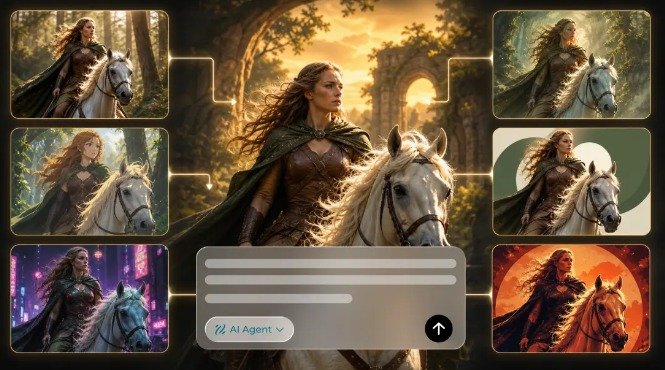
Text-to-image is only one mode. Image-to-image workflows let you upload a sketch or photo and ask the model to reinterpret it, which is useful when you want to keep a composition but change the style. Inpainting lets you select part of an image, such as a distracting object or a bare wall, and regenerate only that area. Upscaling increases resolution so an image holds up at larger sizes. Together these tools turn generation from a slot machine into an editing process.
The quickest way to build intuition is to try ai image generation yourself with a browser-based tool such as Dreamina, changing one word at a time and watching how the output shifts. Swap ‘morning’ for ‘dusk’, or ‘photograph’ for ‘linocut print’, and note what changes. A dozen small experiments teach more than any explanation.
Reading Results Critically
A generated image can look polished while still being wrong. Before using one, check the edges of objects, reflections, shadows, any text, and whether the scene makes physical sense. If the image illustrates a factual article, confirm that it does not imply something untrue, such as a historical event that never looked that way. Treat generated visuals as illustrations, not evidence.
Frequently Asked Questions
How does an AI image generator create a picture from text?
It converts your prompt into numerical form, then uses a trained model, typically a diffusion model, to turn random noise into an image step by step while following the meaning of your text. The result is newly generated rather than copied from an existing picture.
What is a diffusion model?
A diffusion model is a type of neural network trained to reverse a process of adding noise to images. By learning to remove noise gradually, it can start from random static and produce a coherent image that matches a text description.
Why do AI images sometimes have strange hands or garbled text?
Models learn statistical patterns rather than true anatomy or spelling rules. Hands have many small, variable parts, and letters must be exact, so errors show up more clearly there. Newer models improve on this, but careful review is still wise.
Does the same prompt always produce the same image?
No. Generation begins from random noise, so results vary. Some tools let you fix a seed value, which makes repeating a result much more likely when other settings stay the same.
Do AI image generators copy existing artwork?
They are designed to generate new images from learned patterns rather than retrieve stored pictures. However, outputs can sometimes resemble existing work, and legal questions about training data are still being debated, so reviewing platform terms is sensible.
Conclusion
Understanding how a model moves from words to numbers to noise to image takes the mystery out of the process and makes your prompts sharper. You learn why specificity matters, why results vary, and why careful review is necessary. The technology is powerful but not magical, and the people who get the most from it are the ones who treat it as a tool to be steered, tested and checked.